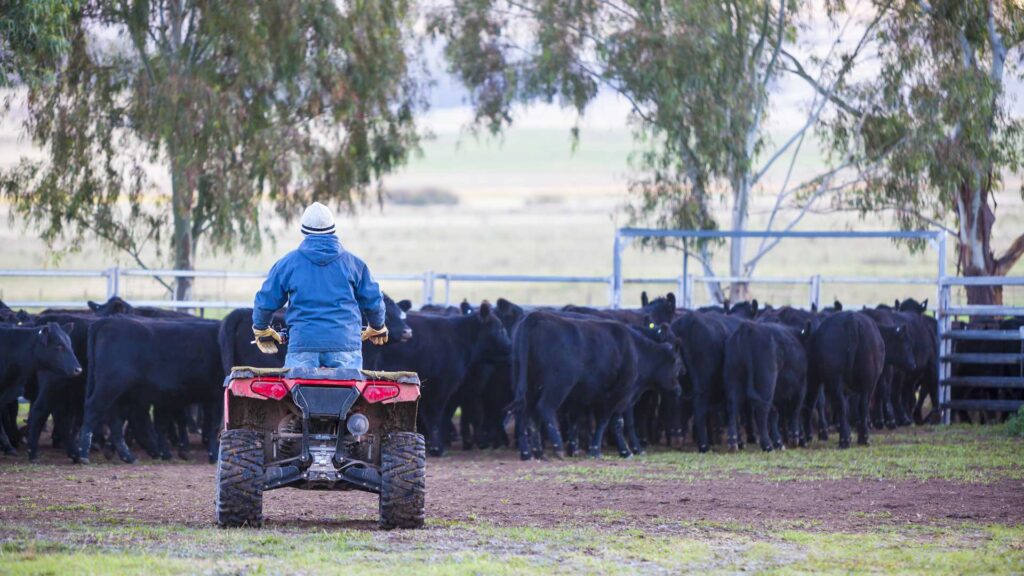
Australia’s agricultural sector is entering 2025 with a markedly different complexion to the past few seasons. According to ABARES, the total value of agricultural production is expected to reach a new record, underpinned by the strength of the livestock industry. High prices for beef, lamb and dairy are offsetting softer conditions in several major cropping markets, creating a clear sectoral divide that is reshaping farm incomes, land values and investment decisions across the country.
Livestock leads a record-value year
Livestock producers are the standout beneficiaries of the current market cycle. Beef, lamb and dairy prices remain historically strong, supported by a combination of tight global supply, resilient export demand and, in many regions, improving seasonal conditions after years of volatility.
- Beef: Reduced cattle numbers both domestically and in key competitor countries have kept global supply constrained. This has translated into firmer prices for both finished cattle and restockers, with northern and mixed-farming regions seeing renewed confidence.
- Sheep and lamb: Sheep numbers remain well below long-term averages following years of destocking. Strong demand from export markets and steady domestic consumption have kept lamb prices elevated, providing producers with solid margins.
- Dairy: Improved farmgate prices, coupled with easing input costs compared with recent peaks, are restoring profitability in many dairy regions after several challenging seasons.
For many mixed and grazing enterprises, livestock is once again the primary driver of cash flow. This has tangible flow-on effects for rural property markets, particularly in grass and fodder-secure regions where buyers are seeking scale, water security and resilience rather than pure production upside.
Cropping sector under pressure
In contrast, broadacre cropping faces a more difficult year. ABARES has highlighted a convergence of challenges that are weighing on profitability and confidence:
- Lower global prices: Increased production from major exporting nations has softened prices for key Australian crops such as wheat and barley.
- Rising competition: Russia, Brazil and North America continue to exert downward pressure on global grain values, narrowing margins for Australian growers.
- Seasonal variability: While some regions have enjoyed favourable rainfall, others remain exposed to dry starts or uneven conditions, increasing risk at planting and yield uncertainty.
What this means for rural property markets
The divergence between livestock strength and cropping headwinds is being reflected in rural land markets across Australia.
Grazing and mixed farms: Properties with reliable water, pasture improvement and carrying capacity are attracting strong buyer interest.
- Livestock-focused returns are improving confidence among owner-occupiers and long-term investors.
- Cropping country: While high-quality, large-scale cropping assets remain tightly held, some regions are seeing more price sensitivity. Buyers are scrutinising soil quality, rainfall reliability and operational efficiency more closely than during the boom years.
- Lifestyle and transition assets: Smaller farms and rural lifestyle properties continue to benefit from structural demand, particularly where they offer a blend of amenity, grazing potential and proximity to regional centres.
Overall, while land values are not experiencing the broad-based surge seen during the peak of the commodity cycle, the underlying fundamentals remain sound – especially where properties align with livestock-driven income streams.
Strategic implications for producers
The 2025 outlook reinforces the importance of adaptability in Australian agriculture. According to ABARES, the sector’s record value is not being driven evenly; it is being shaped by smart allocation of capital and enterprise choice.
Producers are increasingly:
- Rebalancing the enterprise mix toward livestock, where feasible
- Investing in water, fencing and pasture improvement to lift carrying capacity
- Reviewing cost structures and input efficiency in cropping programs
- Prioritising risk management and season resilience over sheer scale
For buyers and investors, due diligence now extends beyond headline hectares and average yields. Understanding how a property performs under variable conditions – and how easily it can pivot between enterprises – is becoming central to long-term value.
Looking ahead
Australia’s agricultural sector in 2025 is proving that strength does not always come from uniform growth. Livestock industries are carrying the baton, lifting overall production value to record levels, while the cropping sectors are working through a period of adjustment in response to global supply and price pressures.
For farm owners, operators and investors, the message is clear: opportunity remains abundant, but it is increasingly selective. Aligning land use, enterprise mix and investment strategy with the prevailing commodity cycle – while retaining flexibility for the next shift – will define success in this new phase of Australian agriculture.